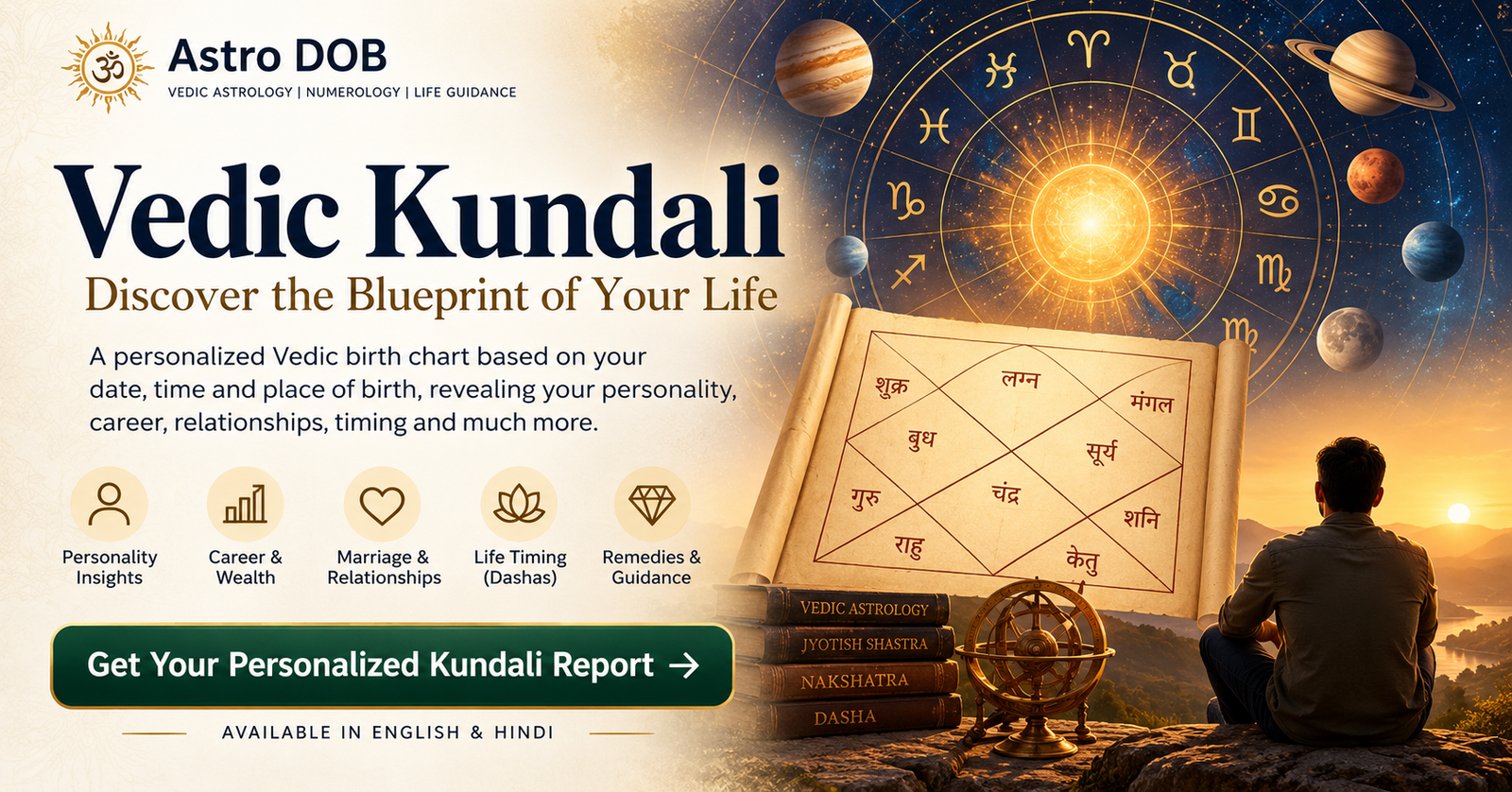
Have you ever wondered what your birth chart actually says about your life?
A Vedic Kundali is more than a collection of zodiac signs. It is a calculated map of planetary positions at the time and place of birth, traditionally used to study personality, life themes, timing, relationships, career and other areas of life.
In this guide, you will learn:
- What a Vedic Kundali is
- Why your exact birth time and birthplace matter
- What the 12 houses represent
- How planets influence different areas of life
- What Lagna, Moon Sign and Nakshatra mean
- What Vimshottari Mahadasha is
- How Doshas and Yogas are traditionally examined
- Why two people born on different dates can have completely different charts
- How to obtain a personalized Kundali report in English and Hindi
What Is a Vedic Kundali?
A Vedic Kundali, also called a Janam Kundali or birth chart, is a representation of the planetary positions calculated for a person's birth date, birth time and birthplace.
In traditional Vedic astrology, the chart is used to examine the relationship between the planets, zodiac signs, houses and other astrological factors.
The important point is that a Kundali is personalized. It is not simply a generic horoscope based on your Sun sign.
Birth details matter. Even a difference in birth time can change important chart factors such as the Ascendant and house positions. That is why a personalized Kundali requires accurate birth information.
What Information Is Needed to Calculate a Kundali?
A traditional birth chart calculation generally requires:
- Date of birth
- Exact or reasonably accurate time of birth
- Place of birth
The birthplace is important because the geographical coordinates and local time zone are used when determining the astronomical positions and Ascendant.
For this reason, simply entering a zodiac sign into a generic horoscope calculator is very different from calculating a complete birth chart.
What Is the Lagna or Ascendant?
The Lagna, or Ascendant, is the zodiac sign rising on the eastern horizon at the time of birth.
It is one of the most important reference points in a Vedic birth chart because the twelve houses are organized from the Ascendant.
The Lagna is traditionally examined when studying areas such as personality, physical constitution, life direction and the overall structure of the horoscope.
Because the Ascendant depends strongly on birth time and geographical location, accurate birth details are particularly important for this part of the chart.
What Is the Moon Sign?
The Moon Sign, commonly called Chandra Rashi or Janma Rashi, is the zodiac sign occupied by the Moon at birth.
In Vedic astrology, the Moon is traditionally associated with the mind, emotions, mental tendencies and subjective experience.
The Moon Sign is also an important reference point for several traditional timing and compatibility calculations.
What Is a Nakshatra?
The zodiac is divided into 27 Nakshatras, or lunar mansions.
The Moon's exact position determines the person's birth Nakshatra. Each Nakshatra is further divided into four padas.
The Nakshatra is particularly important in traditional Vedic astrology because it is used in several calculations, including the starting point of the Vimshottari Dasha system.
Example: Two people may have the same Sun sign but different Moon signs and Nakshatras. Their complete Kundalis can therefore be significantly different.
The 12 Houses in a Vedic Kundali
The twelve houses represent different areas of life. Their interpretation depends on the sign, planetary lordship, planets occupying the house and other relationships within the chart.
| House | Traditional Area |
|---|---|
| 1st | Self, personality, identity and overall constitution |
| 2nd | Family, speech, accumulated wealth and resources |
| 3rd | Communication, courage, skills and siblings |
| 4th | Home, mother, comfort and property |
| 5th | Education, creativity, children and intelligence |
| 6th | Competition, service, debts and challenges |
| 7th | Marriage, partnerships and public relationships |
| 8th | Transformation, longevity, inheritance and hidden matters |
| 9th | Dharma, higher learning, fortune and teachers |
| 10th | Career, profession, reputation and responsibilities |
| 11th | Gains, income, networks and fulfilment of desires |
| 12th | Expenses, foreign connections, retreat and release |
What Do the Planets Represent?
Vedic astrology traditionally examines nine primary planetary influences, including the lunar nodes Rahu and Ketu.
- Sun (Surya) — identity, authority, vitality and leadership
- Moon (Chandra) — mind, emotions and mental patterns
- Mars (Mangal) — energy, courage, action and competition
- Mercury (Budha) — communication, learning and analytical ability
- Jupiter (Guru) — wisdom, knowledge, guidance and expansion
- Venus (Shukra) — relationships, comforts, art and material enjoyment
- Saturn (Shani) — discipline, responsibility, persistence and delays
- Rahu — desire, ambition, unconventional experiences and material fascination
- Ketu — detachment, spirituality and inward development
These meanings are only a starting point. A complete interpretation depends on the planet's sign, house, lordship, relationships and timing.
What Is Vimshottari Mahadasha?
Vimshottari Dasha is one of the major planetary timing systems used in Vedic astrology.
It divides a person's life into planetary periods called Mahadashas. Each Mahadasha is associated with a particular planet and has a defined traditional duration.
The starting Mahadasha is determined using the Moon's Nakshatra at birth.
This means that two people born on different dates, times or locations can have different Dasha sequences and different active planetary periods.
Important: A Dasha period should not be interpreted in isolation. Traditional Vedic analysis considers the planet's placement, lordship, strength and relationship with other chart factors.
What Are Yogas in Vedic Astrology?
Yogas are specific planetary combinations described in traditional astrological texts.
Different combinations are associated with different themes. For example, some classical combinations are traditionally connected with knowledge, authority, wealth, career or other areas of life.
A responsible report should identify a Yoga only when the required planetary conditions are actually present in the individual birth chart.
This is important because generic statements such as "you have a powerful wealth Yoga" cannot accurately describe every person's Kundali.
What Is Mangal Dosha?
Mangal Dosha, also called Kuja Dosha, is traditionally evaluated from the placement of Mars in relation to specified houses and reference points.
Its interpretation should be based on the actual calculated chart rather than assuming that everyone with Mars in a particular sign has the same result.
Traditional compatibility analysis may consider Mangal Dosha alongside other factors rather than treating it as the only determinant of marriage compatibility.
What Is Sade Sati?
Sade Sati is traditionally associated with Saturn's transit through the sign immediately before the natal Moon sign, the natal Moon sign itself, and the sign immediately after it.
Because Saturn is continuously moving, Sade Sati is a transit-based timing consideration. It should therefore be calculated using the relevant Saturn transit position rather than simply reading the natal birth chart.
Why Every Kundali Is Different
This is one of the most important things to understand about Vedic astrology.
A report should not simply give everyone the same interpretation.
Consider two hypothetical people:
Person A
Different birth date, time and planetary positions produce one particular Lagna, Moon Sign, houses and Dasha sequence.
Person B
A different birth time and planetary configuration can produce a completely different house structure, planetary relationships and timing periods.
Therefore, a personalized report should calculate the individual's actual astronomical positions first and then apply the relevant traditional rules to those results.
Why Accurate Birth Details Matter
Incorrect birth information can affect the resulting chart.
In particular, birth time can be important when calculating the Ascendant and house positions. Birthplace is also relevant because astronomical calculations depend on geographical coordinates and local time information.
If your birth time is uncertain, it is better to understand that limitation rather than assume that an automatically generated chart is perfectly accurate.
English and Hindi Vedic Astrology Reports
Astrology information is easier to understand when it is available in the language you are most comfortable reading.
Astro DOB provides personalized reports with both English and Hindi versions, so you do not need to purchase a separate report simply to read it in another language.
Want to see your own Kundali?
Get a personalized Vedic report based on your own birth details, with the report available in both English and Hindi.
Get Your Personalized Kundali ReportFrequently Asked Questions
Is a Vedic Kundali the same as a horoscope?
A daily horoscope is usually a general prediction based on limited information. A Kundali is calculated from individual birth details and contains a much more detailed chart of planetary positions, houses and other factors.
Can two people have the same Kundali?
People born at different times and places generally have different chart configurations. Even when some planetary placements are similar, other factors such as the Ascendant, houses, Nakshatra and Dasha sequence may differ.
Why is the exact birth time important?
The birth time is particularly important for determining the Ascendant and house structure. A significant difference in birth time can therefore change parts of the horoscope.
Can I get my report in Hindi?
Yes. Astro DOB reports are designed to provide both English and Hindi versions so that you can read the same personalized report in either language.
Does a Kundali guarantee future events?
Astrology is a traditional interpretive system. A report should be understood as an astrological interpretation rather than a scientific guarantee of future events.
Disclaimer: Vedic astrology is a traditional belief and interpretive system. Astrological reports are provided for informational and personal guidance purposes and should not be treated as a guarantee of future events or as a substitute for professional medical, financial, legal or other specialized advice.