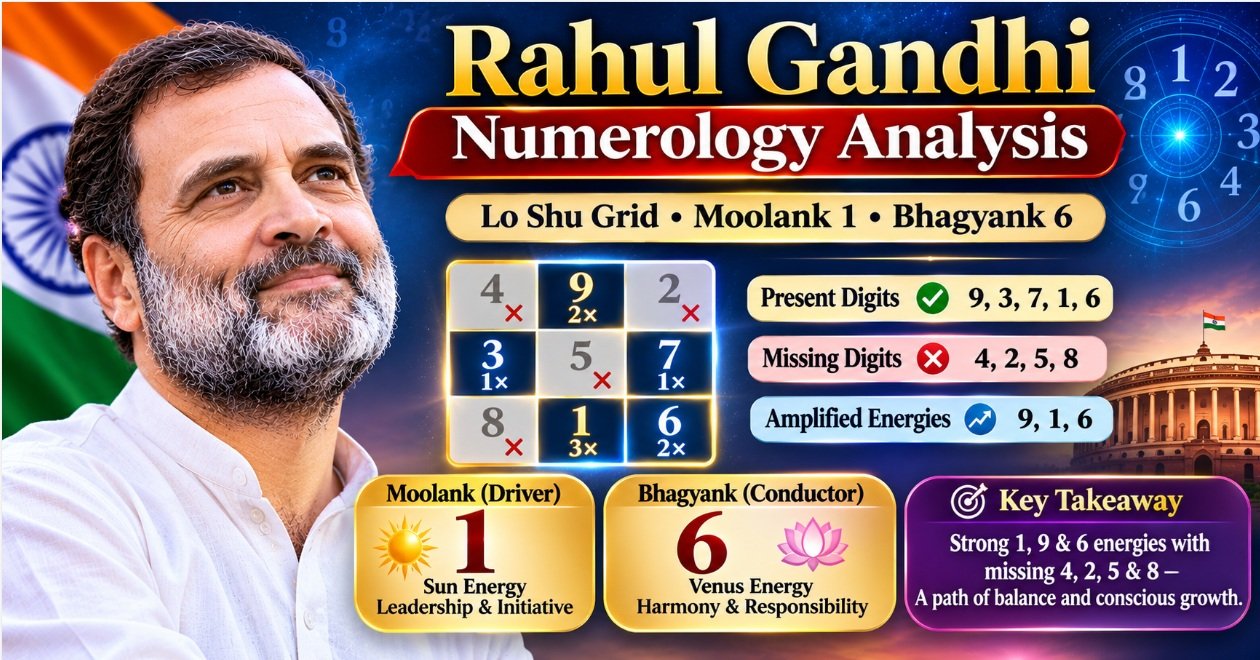
Rahul Gandhi was born on 19 June 1970. According to the Astro DOB Personal Numerology Report generated on 3 November 2026, his core numerological numbers include a Driver Number (Moolank) of 1, a Conductor Number (Bhagyank) of 6, a Kua Number of 3, and a Western Sun Sign of Gemini.
Beyond the basic birth-number calculation, the report provides a detailed Lo Shu Grid analysis. This makes the numerological profile more layered because it looks at which numbers are present, which are absent, and which energies appear more than once.
In this analysis, the Lo Shu Grid contains the numbers 9, 3, 7, 1 and 6, while 4, 2, 5 and 8 are missing. Numbers 9, 1 and 6 are amplified because they occur two or more times.
- Date of Birth: 19 June 1970
- Driver / Moolank: 1
- Conductor / Bhagyank: 6
- Kua Number: 3
- Present Digits: 9, 3, 7, 1, 6
- Missing Digits: 4, 2, 5, 8
- Amplified Energies: 9, 1, 6
Table of Contents
Rahul Gandhi's Core Birth Numbers
The first layer of the analysis comes from the birth date itself.
Driver Number — Moolank 1
Rahul Gandhi's birth date is the 19th. In numerology, 19 reduces to 1:
The Astro DOB report therefore records the Driver Number as 1 and associates it with the Sun. The report describes this number through themes of leadership, confidence and pioneering energy.
Number 1 becomes particularly important in this chart because it does not appear only once. It appears three times in the Lo Shu Grid.
Conductor Number — Bhagyank 6
The complete birth date is used to calculate the Conductor Number:
The Astro DOB report records the Conductor Number as 6 and associates it with Venus. Its traditional description includes harmony, family responsibility, aesthetic appreciation, luxury creation and nurturing qualities.
Interestingly, number 6 also appears twice in the Lo Shu Grid, making its influence more prominent in the overall chart.
Rahul Gandhi's Lo Shu Grid
The Lo Shu Grid provides a different perspective from the Moolank and Bhagyank calculations. Instead of reducing the birth date to one or two principal numbers, it examines the distribution of individual digits.
According to the report, the present digits are:
The missing numbers are 4, 2, 5 and 8. The report identifies 9, 1 and 6 as amplified energies because they occur at least twice.
This creates an interesting contrast: several energies are strongly represented, while four numerical qualities are absent from the birth grid. In traditional Lo Shu interpretation, this does not mean that the qualities represented by missing numbers are impossible. Instead, they are generally viewed as areas that may require conscious development, awareness or balancing.
Number 1 Appears Three Times: Amplified Sun Energy
One of the most noticeable features of this Lo Shu Grid is the presence of three 1s.
Number 1 is traditionally associated with the Sun and themes such as individuality, initiative, confidence and leadership. The report's own interpretation describes the Driver Number 1 through leadership, confidence and pioneering qualities.
When a number appears multiple times, traditional Lo Shu interpretation treats that energy as amplified. Therefore, three occurrences of 1 make the Sun influence particularly prominent.
The Astro DOB report specifically notes that when Number 1 appears more than twice, it can represent excessive fire energy. The report connects this with possible anger or impatience and recommends conscious self-control and patience as balancing qualities.
Three 1s can symbolically represent strong self-expression, initiative and personal drive. At the same time, the traditional interpretation suggests that this intensity benefits from patience, thoughtful communication and emotional balance.
This is an important distinction. An amplified number does not have to be interpreted as purely positive or negative. Its expression can depend on how consciously the energy is managed.
Number 9 Appears Twice: Strong Intensity and Purpose
Number 9 appears twice in the Lo Shu Grid and is therefore classified by the report as an amplified energy.
Within traditional numerology, 9 is often viewed as a number connected with intensity, broad perspective, determination and completion-oriented energy.
When 9 appears more than once, its symbolic influence becomes more noticeable in the overall grid. In combination with the three 1s, it contributes to a chart that contains several strong, active numerical influences.
The report ultimately identifies 9, 1 and 6 as the primary strengths of the grid and recommends using these supported areas to help balance the weaker or missing areas.
Number 6 Appears Twice: Harmony and Responsibility
Number 6 is another amplified number, appearing twice in the grid.
The report associates Number 6 with Venus and describes the Conductor Number 6 through themes including harmony, family responsibility, aesthetic elegance, nurturing qualities and balanced development.
The report's practical interpretation also identifies the present 6 as a supportive influence and connects it with focused effort, integrity and a constructive approach toward growth.
Because 6 occurs twice, these themes receive additional emphasis within the Lo Shu interpretation.
Missing Number 4: Structure and Practical Planning
Number 4 is absent from the Lo Shu Grid.
In the Astro DOB report, the missing 4 is addressed through the themes of stability, structure, practical planning and follow-through. The report recommends creating practical plans and following them consistently rather than becoming stuck in excessive planning.
From a traditional interpretive perspective, the absence of 4 can therefore be viewed as an invitation to consciously strengthen organisation and structured execution.
Rather than treating the missing number as a weakness in isolation, it can be understood as an area where deliberate habits may become particularly useful.
Missing Number 2: Moon, Intuition and Emotional Balance
Number 2 is also missing from the grid.
Traditional numerology associates 2 with the Moon and qualities such as sensitivity, cooperation, intuition and emotional awareness.
The Astro DOB report specifically recommends balancing emotions, strengthening intuition, maintaining a calm environment, journaling and practicing mindfulness in connection with the missing 2.
This creates an interesting contrast with the three 1s. Number 1 represents strong individual and Sun-oriented energy, while missing 2 is traditionally interpreted as an area where greater emotional balance and sensitivity can be consciously cultivated.
Missing Number 5: Communication and Adaptability
Number 5 is another missing digit in the Lo Shu Grid.
The report associates the missing 5 with communication and adaptability. It recommends honest self-expression, networking and developing skills that broaden opportunities.
This is particularly noteworthy because Number 5 traditionally represents flexibility, communication and the ability to adapt to changing circumstances.
With 5 absent from the birth grid, the traditional interpretation suggests that communication and adaptability can be consciously strengthened through experience, learning, networking and respectful interaction.
In other words, the absence of 5 does not mean an inability to communicate. Rather, within Lo Shu symbolism, it identifies communication and adaptability as areas that may benefit from deliberate cultivation.
Missing Number 8: Discipline, Patience and Management
Number 8 is the fourth missing digit.
In the report, Number 8 is associated with discipline, patience and steady progress. The recommended approach includes building routines, respecting commitments and avoiding shortcuts.
From a broader traditional Lo Shu perspective, 8 is also commonly associated with material organisation, responsibility, management and persistence. Therefore, its absence can be interpreted as an area where structure, consistency and disciplined management may require conscious attention.
This becomes particularly interesting when considered alongside the missing 4. Both 4 and 8 relate to practical structure in different ways, making organisation, consistency and disciplined execution important themes in the overall interpretation.
Lo Shu Planes and the Overall Pattern
The report also evaluates several Lo Shu planes. It records the following planes as inactive:
- Mental Plane — 4-9-2
- Emotional / Soul Plane — 3-5-7
- Practical / Action Plane — 8-1-6
- Thought / Planning Plane — 4-3-8
- Will / Determination Plane — 9-5-1
- Action / Movement Plane — 2-7-6
The report also marks both the Golden Raj Yog Plane (4-5-6) and Silver Raj Yog Plane (8-5-2) as inactive.
Rather than interpreting these labels as guarantees of specific outcomes, they can be viewed within the report's traditional framework as indicators of which numerical combinations are complete and which require conscious balancing.
The Most Interesting Contrast in the Grid
One of the most interesting features of this chart is the contrast between amplified 1 energy and the absence of several balancing numbers.
- 1 × 3
- 9 × 2
- 6 × 2
- 4 — Structure
- 2 — Emotional balance
- 5 — Communication/adaptability
- 8 — Discipline/management
This gives the chart a distinctive symbolic pattern. The strongest numerical influences are 1, 9 and 6, while 4, 2, 5 and 8 are absent.
In traditional Lo Shu practice, such a pattern is not necessarily read as simply favourable or unfavourable. Instead, it can be understood as a combination of natural strengths and areas for conscious development.
Balancing the Amplified Energies
The Astro DOB report itself recommends conscious balancing rather than attempting to suppress the stronger numbers.
For the amplified Number 1, the report highlights patience and self-control.
For the missing numbers, the report recommends practical habits such as planning, mindfulness, communication development, networking, routine building and consistent effort.
This creates a useful principle for interpreting the chart: strong numbers represent qualities that can be expressed constructively, while missing numbers can represent qualities that may benefit from conscious cultivation.
Overall Numerological Picture
When the Moolank, Bhagyank and Lo Shu Grid are considered together, Rahul Gandhi's numerological profile presents a combination of strong and missing energies.
The Moolank 1 establishes a strong Sun-oriented foundation associated with confidence, initiative and leadership in the report. The Bhagyank 6 adds themes of harmony, responsibility and nurturing qualities.
The Lo Shu Grid then amplifies this pattern further through three occurrences of 1, two occurrences of 9 and two occurrences of 6. At the same time, the absence of 4, 2, 5 and 8 introduces traditional themes around structure, emotional balance, communication, adaptability, discipline and management.
The report's strongest practical message is therefore one of balance: use the naturally supported qualities while consciously developing the areas represented by missing numbers.
Conclusion
Rahul Gandhi's numerology profile, according to the Astro DOB report, contains several distinctive features. His Driver Number 1 and Conductor Number 6 form the foundation of the analysis, while the Lo Shu Grid adds a more detailed picture of the distribution of numerical energies.
The most prominent feature is the presence of three Number 1s, which the report interprets as amplified fire energy requiring conscious patience and self-control. Number 9 appears twice, while Number 6 also appears twice, making all three numbers significant strengths within the grid.
At the same time, 4, 2, 5 and 8 are missing. Within the report's traditional framework, these numbers point toward areas such as structure, emotional balance, communication, adaptability, discipline and steady progress.
The overall interpretation is therefore best understood as a study of balance between amplified and missing energies. Numerology does not need to be approached as a fixed label. It can instead be used as a traditional framework for reflection on personality themes, habits, strengths and areas of conscious development.
This article presents traditional numerological interpretations based on the Astro DOB report. Numerology is a spiritual and interpretive practice intended for personal insight, reflection and exploration. It should not be treated as a scientifically established method for determining personality, future events or outcomes. The source report likewise states that its interpretations are intended for personal insight, self-reflection and spiritual exploration.